The Old and New Worlds
The Holy Bible
“Search the scriptures; for in them ye think ye have eternal life: and they are they which testify of me.”
John 5:39
 Scripture Realized
History · Faith · Light
Scripture Realized
History · Faith · Light
Ancient truth · Living faith
Discover how the Book of Mormon and Holy Bible speak together as witnesses of Jesus Christ, illuminated by history and language.
One Savior · Two sacred records
The scriptures come from different peoples and places, yet both lead the sincere reader toward the same Redeemer.
The Old and New Worlds
“Search the scriptures; for in them ye think ye have eternal life: and they are they which testify of me.”
John 5:39
Another Testament
“We talk of Christ, we rejoice in Christ, we preach of Christ, we prophesy of Christ.”
2 Nephi 25:26
Study with depth
I seek the setting behind the verse, the meaning behind the translation, and the harmony between sacred records. The goal is not knowledge for its own sake. It is to know Christ more clearly and follow Him more fully.
01
Place scripture within the world of the people who received, preserved, and lived it.
02
Look beneath familiar translations to uncover nuance, patterns, and original intent.
03
Let the Bible and Book of Mormon illuminate one another as witnesses of the same Lord.

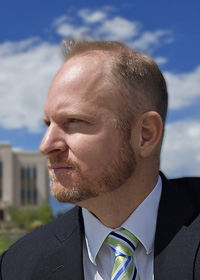
When I was about ten years old, I was listening to my mother talk about the scriptures when something happened that stayed with me for the rest of my life.
For just a moment, the world of the Book of Mormon felt real.
In my mind I saw what looked like a small wooden tower surrounded by tropical trees. It wasn’t a dream, and I don’t claim it was a vision. It was simply one of those rare moments that leaves a lasting impression on a person. What struck me most wasn’t what I saw—it was what I felt.
For a brief moment, I felt as though I had been there.
As though the people described in the scriptures were real people who had lived real lives in real places.
That experience sparked a lifelong curiosity that never left me.
I wanted to know where these people lived.
I wanted to understand their world.
And most of all, I wanted to know what was actually true.
Years later, while working in the freediving community and studying biblical Hebrew, I found myself wondering about a question that combined two of my greatest interests.
The Book of Mormon describes cities that were destroyed at the time of Christ’s death. If one of those locations had been discovered by archaeologists, I wanted to freedive it.
So I began searching for submerged ancient sites throughout the Americas and around the world.
Most of what I found clearly did not fit the time periods, locations, or descriptions found in the Book of Mormon. But one site stood out.
Beneath the waters of Lake Atitlán in Guatemala lay the submerged site of Samabaj.
As a freediver, I was captivated.
As a student of scripture, I was deeply intrigued.
What began as a search for a place to dive eventually became a years-long journey into ancient languages, archaeology, geography, history, and the cultural world of the scriptures.
The deeper I studied, the more I realized something important:
Most people—including many sincere believers—read scripture through the lens of modern assumptions.
We often imagine ancient prophets, cities, cultures, and events according to our own experiences rather than theirs.
Yet when we begin to understand the languages they spoke, the cultures they lived in, the geography they traveled, and the world they actually knew, the scriptures come alive in entirely new ways.
The people become real.
The stories become tangible.
The teachings become clearer.
And many long-standing assumptions begin to fall away.
Over the years I have studied biblical Hebrew, ancient Near Eastern cultures, Book of Mormon geography, archaeology, linguistics, and the historical context surrounding both the Bible and the Book of Mormon. I’ve spent countless hours researching the evidence, evaluating claims, testing theories, and seeking a deeper understanding of the scriptures and the people who wrote them.
What I discovered wasn’t a weaker faith.
It was a richer one.
That’s why I created Scripture Realized.
The purpose of Scripture Realized is not simply to discuss scripture.
It is to help bring scripture into focus.
To help people see the scriptures in their original context.
To explore the history, languages, cultures, and evidence surrounding them.
To challenge assumptions when the evidence warrants it.
And to help us better understand what the prophets, authors, and ancient peoples were actually trying to communicate.
My hope is that through Scripture Realized, the scriptures become more than stories on a page.
That they become real.
That we can better understand them as the people who first received them understood them.
And that by seeing the scriptures more clearly, we can draw closer to the truths they were intended to teach.
Independent research · BMSLR
My search for the world behind scripture also informs my work as an independent researcher featured on BMSLR (Book of Mormon Scientific and Linguistic Research). There, my work appears alongside that of Jerry D. Grover, Jr., Brian D. Stubbs, and John L. Sorenson, bringing my own investigations into a wider body of scientific and linguistic study of the Book of Mormon.
What began more than a decade ago with freediving and a fascination with submerged cities grew into research drawing on ancient Egyptian, Sumerian, Semitic, and Mayan languages, physical recreations, and virtual simulations. My investigations into Book of Mormon voyages bring together historical evidence, a sailor’s perspective, and the analytical habits of a software engineer.
The same curiosity runs through Scripture Realized: to examine the evidence carefully, understand the ancient setting, and make that exploration accessible to others.
Explore my research on BMSLR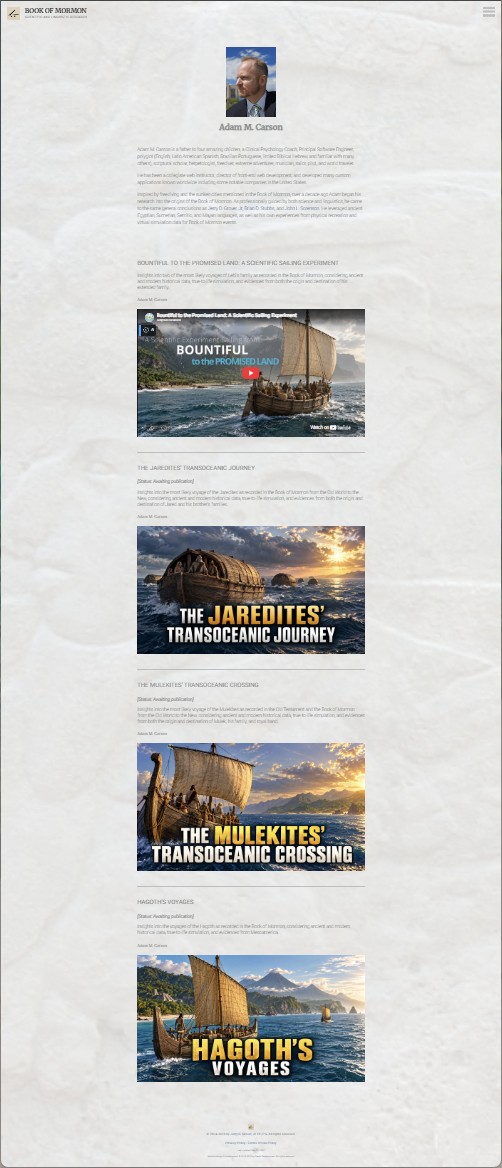
The invitation
Scripture is more than an artifact of the ancient world. It is a living invitation to hear His voice today.
Continue the study
Join the conversation in English, Latin American Spanish, and Brazilian Portuguese.